
Here's How I Got Four Dead Watches Running Again in One Evening at the Kitchen Table, No Jeweler, No Waiting, Four Minutes Each.
 By Mark D. | August 2026
One of them was my father's. It sat dead in a drawer for nine years while I told myself I'd take it in. It was never about finding the time. Here's what I found.
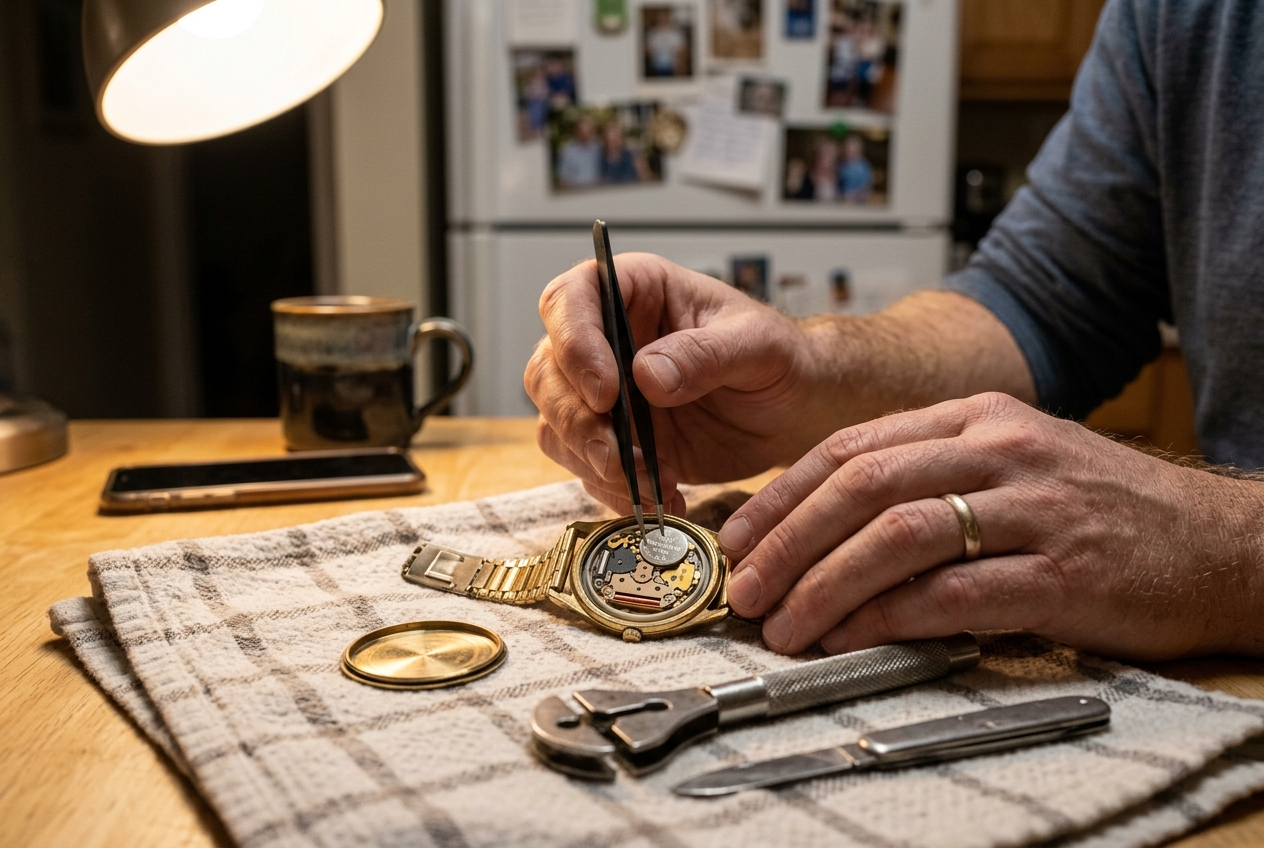
In May a video came across my feed while I was sitting in the parking lot waiting for my son's practice to let out. A guy at a kitchen table. An old watch, face down on a dish towel, the back off. A battery the size of a shirt button between his fingers.
He said one thing in it I haven't been able to shake: the only thing that watch had been waiting on all those years was a drive across town.
I watched it twice without getting out of the car. Because I have a watch like that. It was my father's. It stopped the winter after he died, and it's been in the top drawer of my dresser since 2017 with a note attached in my head: take that in. Nine years of the note.
If you've got a watch in a drawer right now that just needs a battery…
If you've bought a watch online, found the bracelet an inch too long, and gone back to wearing the old one…
If you've ever picked up a watch that belonged to somebody, seen the hands stopped, and thought, "I really need to take that in"…
Then what I'm about to share is the reason that drawer exists. And why it doesn't have to.
Because that watch isn't sitting there because you don't care about it. Not because you're lazy. Not because you forgot. Not because you don't know what you're doing.
The watch is fine. It always was.
But every small thing a watch needs asks you to do the same thing: hand it to somebody else, and come back. A battery. A link out. A new strap. All of it.
And when the shop is forty minutes away and closes at five, that means two trips for a job that takes them four minutes at the counter. So the watch goes back in the drawer with a note. The note lasts nine years. Not because you don't care. Because there's a drive in the way.
That's not a neglect problem. That's a trip problem. And no amount of meaning to is going to fix it.
It kept four watches in a drawer in my house for years before I figured that out.
Here's what I found.
Six watches. One jeweler. Forty minutes each way.
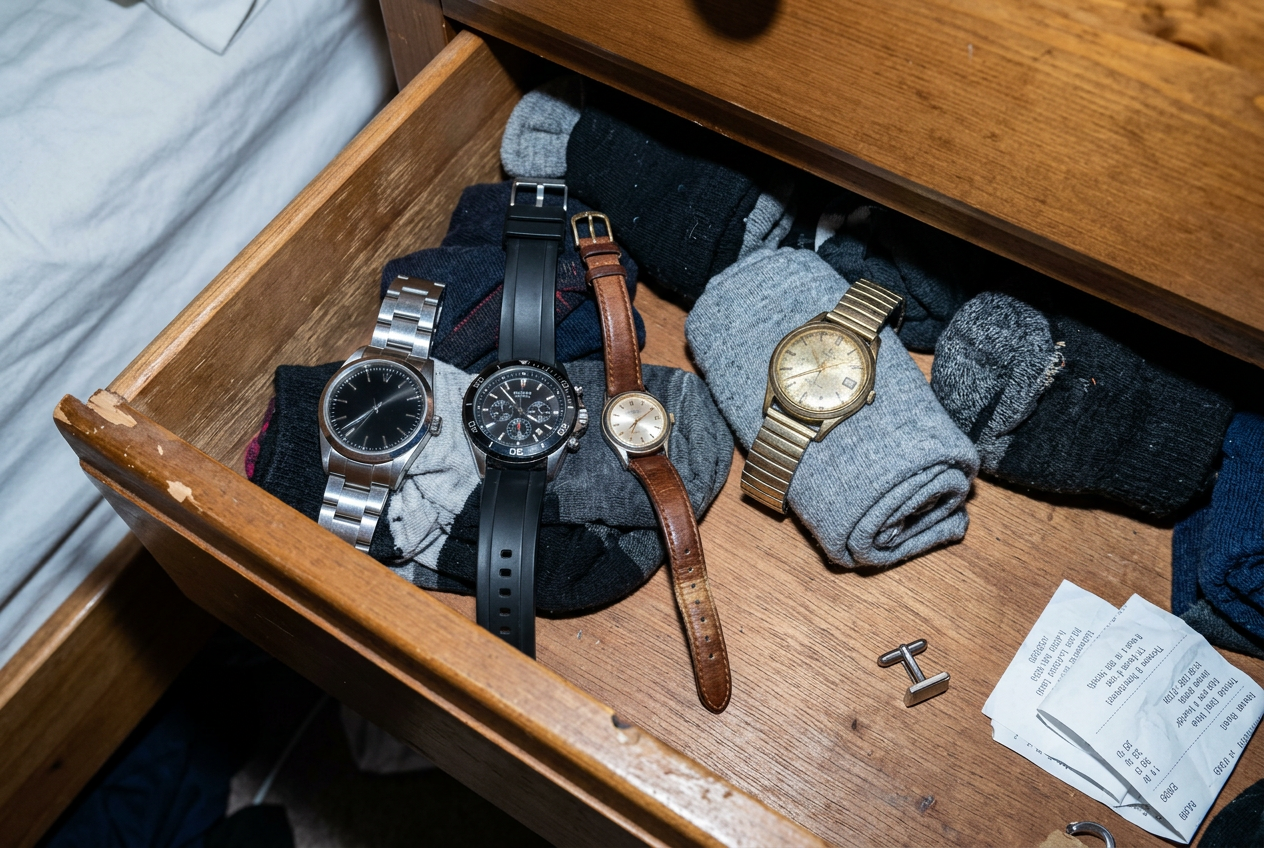
I've got six watches. That's not a collection. That's a daily, a diver I bought online, a beater for the yard, my wife's dress watch, my father's, and one I don't remember buying.
For years there was a jeweler in the mall ten minutes from the house. Then the mall lost its anchor store, and then it lost the jeweler. The closest one now is downtown, forty minutes and a parking garage, and they don't do while-you-wait anymore. Drop it off. Pick it up Friday.
Everything that used to be a quick stop is now a half-day errand. Twice.
So the watches piled up. The diver showed up with a bracelet two links too long and went on the dresser. My wife's stopped. The beater's strap cracked at the spring bar. And my father's stayed exactly where it was.
Every time I opened that drawer, same thing. Four watches I own and don't wear. Two of them just needed a battery.
I never made the trip. Not once in three years. There's always a Saturday that fills up. And it's never one trip. It's two.
Four dead watches. Nowhere handy to take them.
The thing I never said out loud
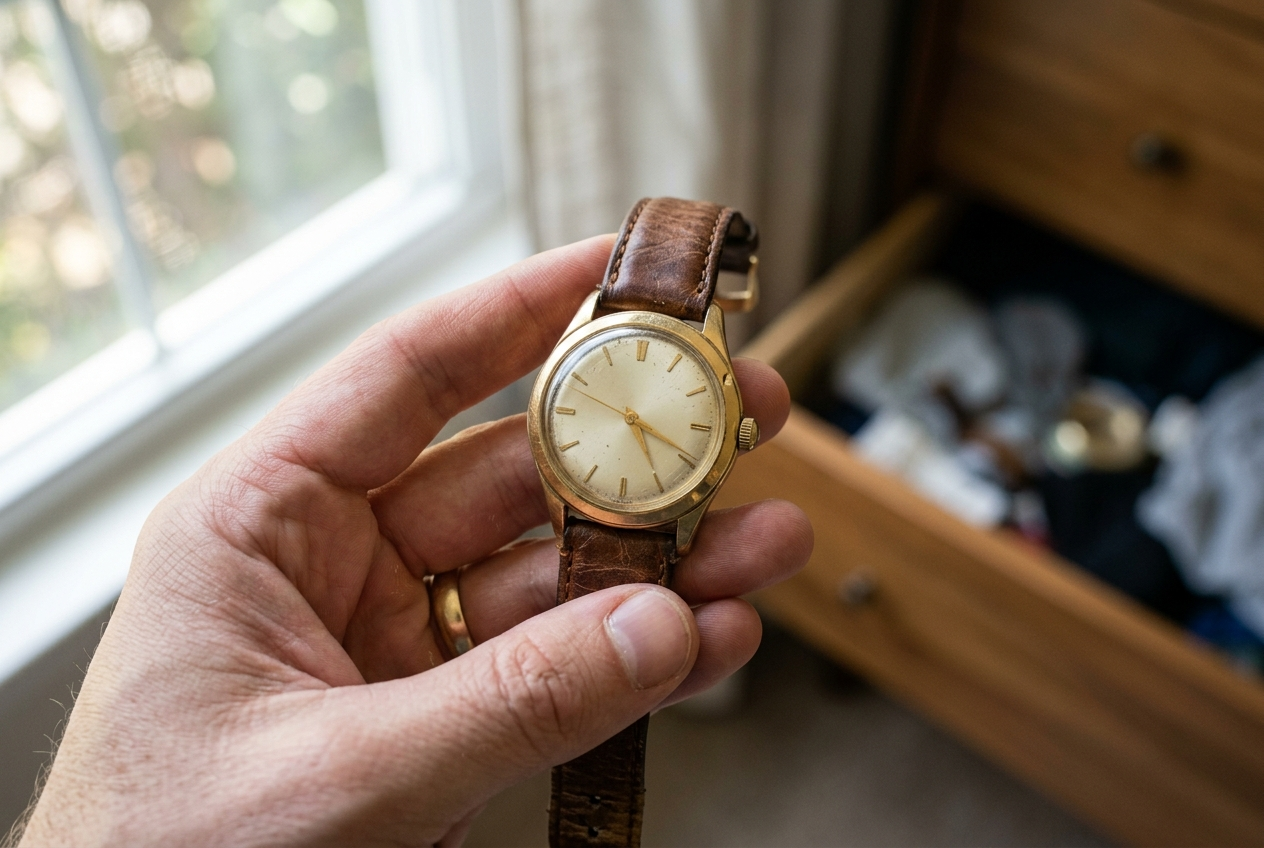
Every time I saw his watch, same thought:
"If I'd just made the drive, it'd be on my wrist by now."
You don't say that to anyone. It sounds like you couldn't be bothered to drive downtown for your own father's watch.
I thought that for nine years. Quietly. Never said it to my wife. My son was six when his grandfather died, and he doesn't remember the watch on his grandfather's wrist. He knows it from the photo on the fridge. My dad at the lake, sleeve rolled up, that watch.
I just figured everybody else got theirs fixed.
Which is why that line in the video landed the way it did.
What I didn't realize the drawer was costing me
And the whole time, the watches were paying for it.
The money wasn't the thing. Twenty dollars at the counter for a battery or a link wasn't what kept me away. The drive was.
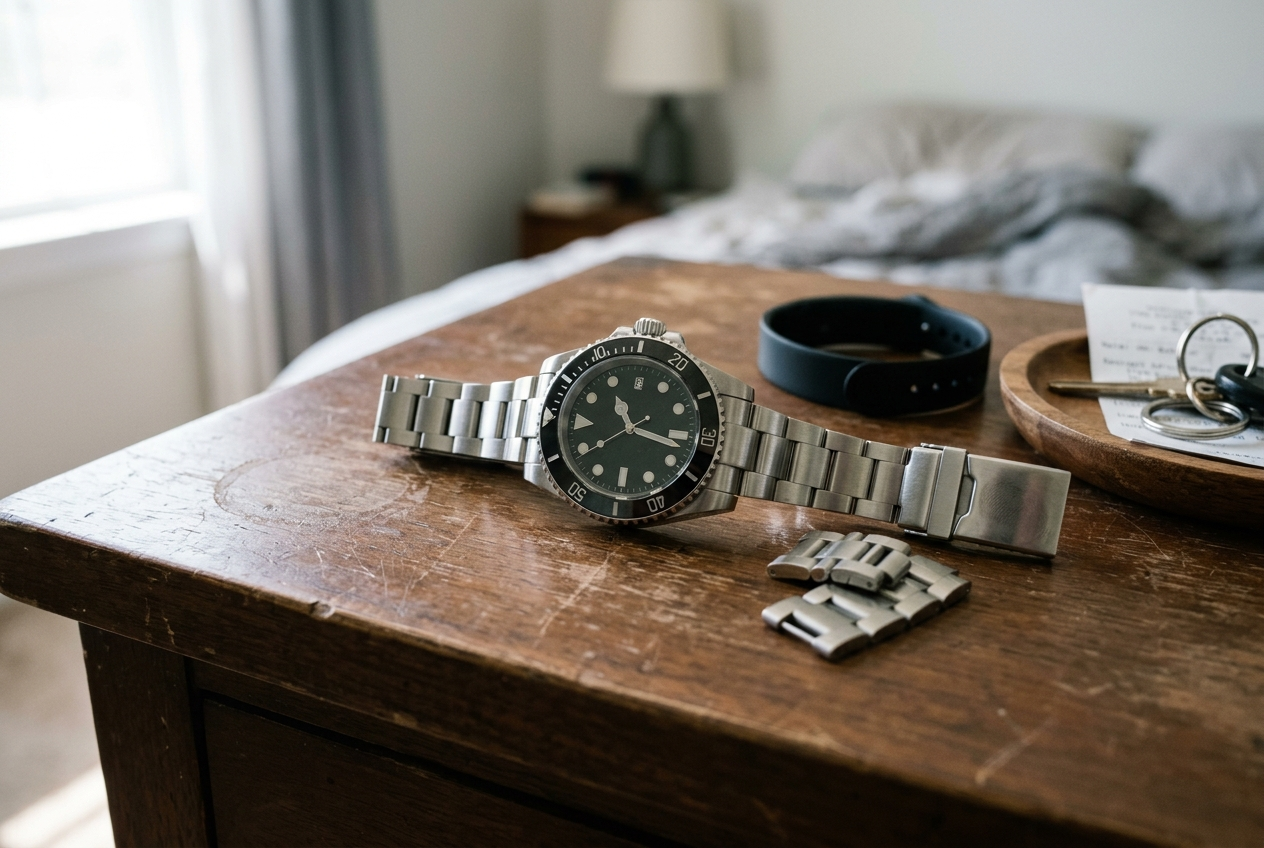
But a watch you don't wear is a watch you already paid for. The diver cost real money and it's been on the dresser since the day it arrived, bracelet splayed open like it's waiting for somebody bigger. Every day it sits there, it's costing me the thing I bought it for.
My wife stopped wearing a watch at all. Said she'd take hers in when I took mine. Neither of us did.
And the one that mattered wasn't costing me money. It was costing me years. My son's fifteen. He's never seen it run.
Nine years of that. Open the drawer. Close the drawer.
The night I laid them all on the table
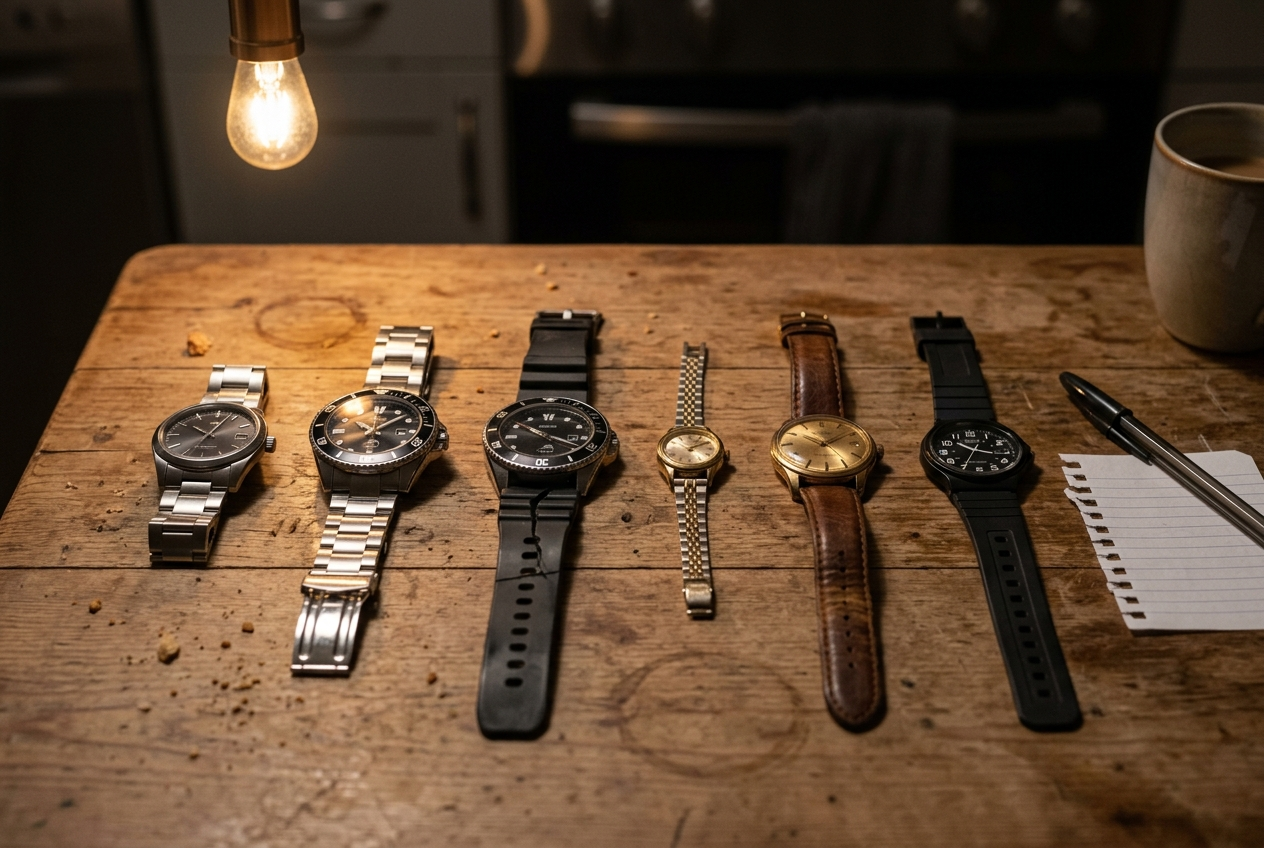
The guy in the video did one watch. I decided to count mine.
I got home from practice, opened the drawer, and put every watch in the house on the kitchen table. Six of them.
Two were running. Four weren't being worn. So I wrote down what was actually wrong with each one.
The diver: two links too long. My wife's: dead battery. The beater: cracked strap, one spring bar snapped. My father's: dead battery. That's it. That's the whole list.
Four watches. Four drop-offs. Four pick-ups. Eight drives downtown at forty minutes each. Call it ten hours in the car to fix four watches that aren't broken.
Because none of it was broken. A battery is a battery. A link is a pin. A strap is two spring bars. Nothing on that table needed a watchmaker. Everything on that table needed a drive.
None of it was broken. All of it was inconvenient. And I'd spent nine years treating inconvenient like broken.
That's the whole thing. That's the drawer.
So I stopped waiting for a free Saturday to drive downtown. And I went back and watched the video again, this time watching his hands.
What he was using wasn't a repair kit. It was the four things the jeweler does at the counter.

I'd assumed there was something on the jeweler's side of the counter I didn't have. A skill. A bench. A drawer full of parts.
There isn't. For a battery, a link, a strap, or a case back, the jeweler isn't doing anything you can't do at a kitchen table. The only thing he has that you don't is the right tool already in his hand.
The guy in the video wasn't a watchmaker. He was a guy with a kit that's sorted by job instead of by piece. Four jobs: resize the bracelet, swap the strap, open the case back, change the battery. Two or three tools for each, already matched, so you're never guessing which of the pointy things you need.
It's called BandForge.
There are more tools in the case than you'll use. Six do the work. The instructions in the case tell you which six, and what each one is for.
I ordered it that night. It came in a zipped case that fits in the kitchen drawer. Nothing to set up. Nothing to charge. The battery a watch needs is the size of a shirt button, and its number is printed on the old one.
I didn't do my father's first. I'm not proud of that. I wanted to know my hands could do it before I touched his.

So the diver went first. Turn the bracelet over and there are small arrows stamped inside the links. The pin comes out the way the arrow points. Seat the bracelet in the holder, set the pusher on the pin, a few light taps, and it slides out. Two pins out, one back in, two links gone. Put it on. It fit. Two years on the dresser, over in about four minutes.
Then my wife's. Snap-on back. There's a small lip at the edge where the flat blade goes. Blade under the lip, a firm lift, the back pops. Battery out, read the number on top, new one in the same way up, press the back on with your thumbs until it clicks. Running.
Then the beater. The forked end of the spring bar tool, compress, lift, old strap off, a strap I'd had in a drawer for a year on. Done.
Then his.
Screw-down back, the kind with notches around the edge. The three-prong opener sets into three of them. Seat it, press down, turn. It's stiff for a quarter turn and then it isn't. A few turns and the back lifts off. Inside: a battery the size of a shirt button, the number printed right on it. New one in. Back on. Threaded down snug.
I turned it over.
The second hand was moving.
I sat there a while.
Four minutes. Nine years.
No appointment. No counter. No "pick it up Friday." No second trip.
And because each one is four minutes at a table I'm already sitting at, I don't put them off anymore. A watch stops, it's running again that night. Not next month. That night.
The first week the drawer was empty. By August I'd stopped thinking about it.

First week: my wife had hers back on. She didn't say much about it. She just wore it.
By June the diver had gone to work more days than the daily. I kept catching myself looking at it.
July, the beater went back into the yard rotation.
And his went on my wrist and stayed there. Every day. I set it by my phone in the morning. It keeps time like it never stopped.
One honest thing. If a watch is actually broken, a movement that's gone, a cracked crystal, water inside, that's still a watchmaker's job, and I'd still make the drive for it. But nothing in my drawer was broken. Nothing in most drawers is.
A couple of weeks ago at dinner my son looked at my wrist and stopped chewing. He said:
"Is that the watch from the fridge?"
It is. It's been running since a Tuesday in May.
Nine years in a drawer. Four minutes at the kitchen table. That's all that was ever between them.
You already know which side of this you're on
You keep the drawer. Tell yourself you'll take them in. Wear the watch that fits instead of the one you want to wear. Open the drawer, close the drawer, and let the note run another year.
Or you take the drive out of it. Four jobs, at the table, with the right tool already matched to each. On a night you're already home. On the watches you already own.
And see what's on your wrist next week.
If that video was describing you the way it was describing me, you already know which watch you'd do first.
If it doesn't do the job on your watch, send it back within 30 days. The risk is on them, not you.
